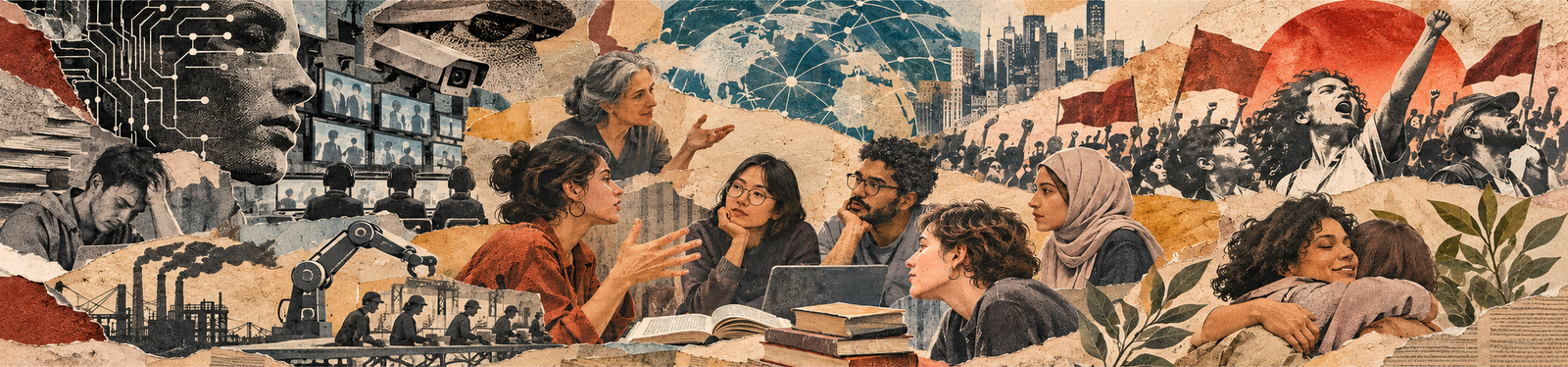

When we talk about insecurity or precarity, we usually understand them as consequences of the failures of an economic system. And they really are. Amid widespread unemployment, major companies are cutting jobs as they introduce AI and automation. We have reason to believe that precarity has become a norm of our working lives. Are we scared? We most certainly are. For many of us, the future of work feels more uncertain by the day. Some of us may lose our jobs, others may struggle to find work, and those of us who have jobs may have no idea how long we will keep them. These are the conditions under which we now navigate and negotiate our labour relations. Pierre Bourdieu, in his 1997 talk Job Insecurity is Everywhere Now, calls this objective insecurity.
Does the same economic system that produces this insecurity also benefit the ruling class at our expense? Can the ruling class use this very insecurity as a means of domination to govern workers? Bourdieu's concept of generalised subjective insecurity helps us answer these questions. The material conditions that make employment insecure also shape what people think they can demand, refuse, or challenge if they want to find or keep a job.
Over the past few decades, the neoliberal reconfiguration of the economy has enabled corporations to extend their operations across national borders, giving them access to new markets and to lower-wage labour. It has also changed the terms on which workers sell their labour power. To find or keep a job, they increasingly have to compete with workers elsewhere in the world. Where large numbers of educated and skilled people form a reserve army of labour, even temporary and insecure work can seem like a chance to enter the labour market. For companies, the same arrangements offer a way to cut labour costs. The greater the competition for jobs, the easier it is to hire at lower wages. At the same time, flexible employment can keep workers in constant fear of losing their jobs. When work itself becomes a scarce commodity, having a job begins to feel like a fragile privilege that could be taken away at any moment. Bourdieu adopts the term flexploitation for this "rational management of insecurity." The political advantage of flexibility lies in what employers can do with that fear. It gives them leverage over both the terms workers will accept and how workers conduct themselves. This is how the ruling class can use insecurity to maintain its dominance over the working class.
What does this management of insecurity look like? We can think of two groups. One consists of people who have work. The other consists of people who are currently out of work or have yet to enter the workforce. Each group looks at the position of the other to judge what is possible and what is risky for them. It is through these judgments that we can see how objective insecurity becomes generalised subjective insecurity. Someone who has a job can see that many educated and skilled people are out of work. Any one of them might take their place. This prospect affects how they bargain over working conditions. They think twice about asking for a raise or objecting to their working hours. At the same time, they regulate their own conduct. They consider what the company will see as serving its interests, what it will interpret as opposition, and what might provoke a backlash from their employer.
If we extend this idea to people who are out of work or have yet to enter the labour market, the same logic operates in the other direction. They look at people who have jobs to understand what an ideal worker looks like in the eyes of an employer. If silence and the absence of resistance become the norm among those in work, prospective workers can learn from them what demands they can make, what wages they can ask for, what hours they are expected to accept, and what conduct is considered acceptable. One person regulates their conduct for fear of losing a job. The other models their conduct on those already employed in the hope of finding one. Insecurity thus becomes a governing logic that shapes both the terms of labour and the conduct of current and prospective workers in the interests of the ruling class.
The consequences of this self-regulation extend beyond wages and working hours. As Bourdieu argues, casualisation makes the future so uncertain that it undermines the "basic belief and hope in the future" that people need in order to rebel, especially collectively, against even the most intolerable conditions. When workers cannot make reliable plans for their own lives, it becomes harder to believe they can change those conditions together. This is where demoralisation and what Bourdieu calls a "loss of militancy" set in. People may recognise an injustice and still hold back because they cannot count on others to stand with them or afford the consequences if they do. The same adjustments that help people keep a job or remain employable can therefore erode their collective capacity to resist exploitation.
For Bourdieu, confronting generalised subjective insecurity also requires confronting the objective insecurity on which it rests. One way forward is for workers to stand together to hold on to their dignity. The system that puts workers in competition with one another operates internationally, so mobilisation and solidarity must also take shape at that level. This requires moving away from an individualistic view, so that workers can see themselves as people capable of joining with others to change the conditions under which they work. A view that reduces them to calculators of individual gains and losses leaves little room for that possibility.
The problem is that once insecurity becomes a way of governing workers, it becomes extremely difficult to build a labour movement against it. To understand the repeated setbacks suffered by labour movements, we need to look at both the material insecurity of work and the ways in which the ruling class has been able to shape what workers believe they can demand, how they think they can act, and what forms of resistance they consider possible. This has become pressing again. As AI reconfigures work across many fields and objective insecurity becomes acute once more, the question of a way forward returns. Drawing on Bourdieu, I have argued that the ruling class can use insecurity to govern workers. What this leaves open is how people can navigate, negotiate and bargain within these changing conditions of labour. That question, for now, lies beyond the reading of the present author.
Reference
Bourdieu, P. (1999). Job insecurity is everywhere now. In Acts of resistance: Against the tyranny of the market (R. Nice, Trans., pp. 81-87). The New Press.
Image generated by ChatGPT.
Leave a Reply